Basics
Home and SearchSite Guide
Brentford Basics
Privacy Policy
Contact
People
FamiliesPhotos of people
Name indexes incl WW1
Memories
Lists, Documents, News
Occupations
Properties
Properties: High StreetProperties: non-High Street
Photos
Maps
1909/10 Valuation Index
Pub Hub
Can You Help?
Seeking...Mystery photos
Roads Off
A-Z listJanet's Research
HistoryBeach's Jam
Nowell Parr
Turner the Artist
Queen Victoria 1840
Brentford Market
80 High Street
Clitherow of Boston House
Four Croxford Brothers
Sources & More
They SaidBooks etc.
Web Links
Next
Site Technology
Author
Home and Search
Not Brentford
196 - 208 High Street, New Brentford
This section of the High Street starts on the eastern corner of the Market Place and includes two ancient coaching inns, the Red Lion and Castle Hotel.
In the 1871 census this stretch is numbered, starting at 1 for the (unoccupied) property on the corner of the Market Place and reaching 14 at The Castle Inn. There are only 13 properties in this stretch which fronted the High Street (and they became numbers 196 - 208). I think the anomaly arises as the Castle Inn is made up of three inhabited buildings on the tithe map (1838): numbers 207 and 208 plus a small property behind no. 207. In the 1909/10 there is no mention of no. 207, suggesting number 207 became part of the Castle.
The High Street numbering in this part seems to have been just for the 1871 census: the whole High Street was numbered in 1876.
The area was redeveloped and the building line from number 191 to the Half Acre set back in the 1960s, leaving a wide pavement with flower beds (L). A plan from 1997 shows the new properties were numbered with 196-198 facing the High Street but set a little further back than the Town Hall frontage. Adjoining 198, number 199 is at right angles, looking across to Market Place, as are numbers 200 to 202. Then 203 onwards front the High Street. They are not in identical locations to the original numbers 196 onwards.
Properties
Notes prepared for numbers 196, The Red Lion (197), 198, 199, 200, 201, 202, 203, 204, 205, 206, 207 and Castle Hotel (208); also a list of photos, ephemera and maps
Number 196
The property on the eastern corner of Market Place. John George Goddard, dealer in fancy goods (1851) and toy merchant (1861) lived here with his family. By 1871 the building was uninhabited. The 1890 directory lists 'Goddard, Croxford & Furness, auctioneers, land, house & estate agents & valuers' at this address and a caretaker and his family lived here at the time of the 1891 census.
When the 1909/10 Valuation records were compiled, the property was assessed along with the adjacent no. 1 Market Place. At this point the occupiers of 196 were 'Boots Cash Chemists Ltd' (1 Market Place was empty) and the owners Misses Emily & Olivia Stein, of 37 Netherhall Gardens, Hampstead.
The condition of no. 196 High Street and 1 Market Place was described as 'new' so presumably they had been (re)built within the last decade. Boots remained in business here until at least 1940, when they were listed as simply 'Boots the Chemists'. D & L Kay & Sons used these premises in 1978.
The Red Lion (197)
Originally a coaching inn, it may have been running as early as 1446 (reference to Henry IV holding a Chapter of the Garter at the 'Lion' inn of Brentford (Q63)). New Brentford church services were held at the Red Lion in the 1760s, whilst the church of St Lawrence was rebuilt (Q49).
The 1836 Poor Rate shows 'Pearce' at the Red Lion and the 1839 Pigot directory records, Sarah Pearce as the publican. There is a PCC will for Isaac Pearce, licensed victualler of New Brentford dated 1835, presumably her husband.
By 1851 Frederick Shipley had taken over, and he is listed in the 1861 census too. Vic Rosewarne found record that he died and the licence was transferred to his executors in early 1863: the executors were Eliza Shipley, his widow, John W. Cole and Hickson Briggs. Within a couple of months Edmund Meacock had taken over the licence from the executors, but in three years the licence was transferred again, from Meacock to Thomas Joseph Beasley in June 1866.
There is some confusion with forenames, but it was reported that GEORGE Thomas Beasley died on 20 Aug 1866 'in the 32nd year of his age' at the Red Lion, according to the Morning Advertiser, 25 Aug 1866. In November the Red Lion's licence was transferred to Mr John Schooling the adminstrator for Beasley and then to John Whetherley in early 1871, resident in the 1871 census. Another transfer took place in April 1876 from John Wetherley to Robert Thomas Finch April 1876 and then from Robert Thomas FITCH to George Loader, May 1878, who was recorded here in the 1881 census.
Vic Rosewarne's records of licence transfers by pub name fills in the gaps between the censuses.
Another transfer took place in Jan 1887 from Loader to George Harris, then another change must have occurred as William Henry Fear was recorded here in 1890 & 1891. William Farmer or Farriner, from Brighton, Sussex was the landlord when the 1901 census was taken. At some point before 1907 Thomas Sangster ran the Red Lion, his name visible on signage in a postcard sent that year: see list of photos, ephemera and maps for link.
By 1911 Richard Boxall, 49 and his wife of 18 years, Louisa Emily, 40, were the landlord and lady of the Red Lion. They had two live-in barworkers, Ellen Trumper, 34 and Edwin Etches 28. The living accommodation comprised 5 rooms: bars, bathrooms etc were not counted. Richard Boxall may be a descendant of George Boxall, who ran the Magpie & Crown at no. 128 in the late 1830s to mid 1840s.
The valuation on 3rd December 1914 describes the property as '3 storey building, upper part cement faced. Painted lower part with wood front and glazed with double swing doors; green tiled dado to centre. Wood cellar flap in pavement
- Ground floor: 2 public saloon & bottle bars; kitchen; scullery & parlour; outside WC
- Basement: cellar
- First floor: 3 rooms
- Top floor: 2 rooms, bathroom & WC.
Good condition. Urinal in yard at rear. 20' frontage.
The occupier was Richard Boxall, the owner Truman, Hanbury, Buxton & Co Ltd, Brick Lane, Spitalfields. Freehold, term - yearly, from 18 Jan 1909. Rent £52. Gross value: £2375.
The Red Lion closed in 1928 and the London Co-op opened here in the same year, remaining here until at least 1940. Used by Barclays Bank in 2003 and is now the first building after the Market Place (L).
Number 198
A pawnbroker's shop in 1836 (widow Jones) and 1839 - 1845 (John Jones), then a cheesemongers 1851 - 1861 (Mark Hayes and Henry Goldsmith); Benjamin Rea, oil & colorman was established here by 1871 and is listed in 1881 & 1891; Joseph Mitchell, oil and colorman manager in 1911; Henry Knight oilman is listed here in 1913; later this was a fruiterers & butchers.
It is remembered as a 'double fronted butcher's shop' and when valued in 1915 was described as 'occupied by an oilman, with stable, storehouse, WC and shed at rear ... the whole in very fair condition'. It had a frontage of 22'. See 199 for details of owners. The 1911 census records it having six rooms.
Number 199
These premises were used for many purposes: Charles Kayes coal merchants (1841); Charles Kayes green grocer (1851); James Ward marine store dealer (1861); Edward Solly Fagg general dealer (1871); James Stone leather seller (1881); John Farnsworth taxidermist (1890); George Farrant butterman (1891); John Beard Staples cheesemonger (1898); Samuel Smith provision merchant (1901).
The 1909/10 Valuation describes no. 199 in February 1915 as a stock brick built and tiled shop occupied by Pearks with wood and glazed front and tiled dado. No yard, small warehouse at rear, detached from main premises. Small frontage with first and top floors built over right of way (public) entrance to Red Lion Yard.
Ground floor: tiled shop & storeroom with warehouse detached at rear. First floor: 2 rooms; top floor: 2 rooms. Outside WC. In fair condition. There was a tenancy agreement running for 14 years from midsummer 1897.
Pearks continued to trade here until at least 1940.
At the time of compiling the 1909/1910 Valuation Records, numbers 198,199 & 200 were owned by Miss M A Leader, 79 Goldhurst Terrace, West Hampstead and Mrs M E Hawkins, 13 The Mount, Reading.
Number 200
Fruiterers from 1836 - 1891: James Pearce 1836, 1839, 1841 1845; in 1851 he is described as an 'orange merchant'; William Pearce fruiterer and 'br(other)? to head' is listed in 1861; James E Pearce fruiterer 1871; Charles J Coombs, orange merchant, 1881; Robert Smith orange merchant/fruiterer 1890/1891; by 1901 the shop was a hairdressers & tobacconists run by Leonard Martin from Chelsea. The 1911 census shows Leonard Martin was 38 and had been married to Clara (36, born Pimlico) for 14 years; they had two sons, Frank 5 and Roland 7 months; both his wife and sons were 'assisting in business'. Lilian Drummond, a 32 year old servant lived with the family and was a tobacconist assistant: she was born in Basingstoke.
Leonard Martin remained here until at least 1940; in the 1952 electoral register Clara Martin, his widow, was recorded at this address.
In 1978 Legal Office Services used these premises. See no. 199 for the details of the owners in 1915.
Number 201
In 1841 two properties following number 200 were unoccupied.
In 1851 George Aston, a married butcher born London, age 65, lived here, no sign of his wife. His unmarried son William, also a butcher, born Hackney age 30 completed the household.
By 1861 George had died, his widow Ann headed the household and ran the shop, her son William assisted and they employed Maria Downing to do the house work.
In 1871 number 201 remained a butchers, now run by Henry Oldham, widower born Warwickshire, with his younger married sister Maria (Skemp?) and her family plus a shop boy John Lock completing the household. Henry remained at 201 until at least 1881 (census) and he is also recorded here in an 1882 trade directory.
By 1890 Arthur Holton was running his butcher's shop from this address, possibly a relative of Frederick Holton, who was a butcher at 96 and 153 High Street.
The 1891 census shows Walter Barratts, a 25 year old journeyman butcher, born Buckinghamshire, living at 201: he was "employed", possibly by Holton. A 17 year old journeyman butcher, Herbert Beacher, Beaches or Beachy, born Richmond Surrey, shared the property.
In 1901, after approaching 50 years as a butchers, no. 201 was occupied By Henry A. Cook, an assistant boot and shoemaker and his family. He lived next door to Edwin J Clark, a 'retail boot manager' - both were 'workers' (not employers) in their late 20s.
The 1911 census reveals some elaborate forenames for Henry and his family:
Henry Ambrose Cook, head, mar, 39, salesman, boot shop, worker, born Spring Grove
Ada Charlotte Cooke, wife, mar, 38, born Brentford
Ernest Henry James Cook, son, 18, clerk, tobacco factory, worker, born Brentford
William John Cook, son, 17, apprentice, printers, worker, born Brentford
Percy Francis Cook, son, 14, school, born Brentford
Frederick Charles Redvers Cook, son, 11, school, born Brentford
Henry and Ada had been married 18 years and their four sons had all survived. Their home had three rooms.
1907, 1911 and 1913 trade directories record George Dare, bootmaker, at nos. 201 and 202; his saleman and managers occupied the two properties but George Dare lived elsewhere.
The 1909/10 Valuation describes the property in 1915 as owned by William George Leader and occupied by 'R Dare': the note points to no. 200 for details, suggesting the two properties were built at the same time. No. 201 was rented for 21 years from 1893, annual rent £24 for first 14 years, £30 for remaining 7 years.
No. 200 (and presumably 201) was a 3 storey brick, cemented and tiled shop and premises of shallow depth with wood and glazed shop front.
In 1920/1 Aubrey King, electrical engineer was recorded at no. 201. In 1933 Fred Baul, ham & beef stores and in 1940 George Kingsman, fruiterers.
Number 202
In 1841 two properties following number 200 were unoccupied.
Owned and occupied by the Dare family from 1851 to 1890 and used as a shoe and bootmakers in 1851 through to (at least) 1940.
In 1851 William Dare was 41, married with three sons and worked as a shoemanufacturer employing six men: the business was well-established. He was born in Windlesham Surrey and his wife Elizabeth was from Wiltshire. In 1841 he, his wife and eldest son Richard, age 1, were at Boston Lane, Brentford. His middle son, George Dare, was 3 in 1851 and later ran the business. In 1861 he was not with his parents at number 202 but was staying with his uncle Richard Dare, a boot seller in Hammersmith.
William Dare was recorded as a shoe warehouseman in 1861 and shoe salesman in 1871, by which time his son George, 23, was at home. Two unrelated women in the houshold of 1871 were 'assistants', presumably in the shop.
In the 1881 census number 202 was recorded as shoe shop run by George Dare. George had married Mary Ann Wallis from Worplesdon, Surrey in 1874 and their son Percy was 6. Living with them were two Dare nephews ages 14 and 13, both born in Hammersmith - presumably relations who were helping in the shop to gain experience.
In 1891 number 202 was occupied by the Martin family, the father, Henry, was 30 and a 'boot business manager' born Aldershot. Only his youngest child, age 1 was born in Brentford and presumably Henry had been employed as a manager by Dare in recent years. George Dare and family lived nearby on Somerset Road, he was working as a bootmaker and and was an 'employer' rather than 'employed'. Mary Ann Dare’s death was registered in Brentford in the last quarter of 1902, age 45, and in 1901 George Dare was living with his elder brother Richard Dare and family at 36 Castelnau, Barnes, Surrey. George had 'no occupation', Richard Dare was a 'boot and shoe factor' and was an employer.
The business at 202 High Street continued and expanded into no. 201: 1907, 1911 and 1913 trade directories record George Dare, bootmaker, at nos. 201 and 202.
In the 1911 census Edwin Jabez Clarke, retail boot manager, 33, lived here with his wife Maud, 34, daughter Stella 8 and son Norman Cecil 3. The property had 6 rooms. Presumably Clarke was employed by George Dare.
In the 1909/10 Valuation (which took place in 1915) no. 202 is described as a 3 storey brick, cemented and tiled shop with external one storey shop and dwelling extension to the ground floor at the rear. The property was in good condition and had a small conservatory. It was leased by George Dare to Edwin Jabez Clarke.
Edwin J Clarke remained here in 1921, a bootmaker. Freeman Hardy and Willis, bootmakers, were recorded a few doors along at no. 205 in 1921: competition.
Charles Collins, bootmaker was recorded at no. 202 in 1933.
By 1939 the premises may have been split into a shop and flats. There were eight residents with a mix of surnames: Burdon, Stanley and Maill. None match the names of the business recorded here in 1937 and 1940: Roberts & Watson, bootmakers.
Following rebuilding, number 202 was used by solicitors:
- In 1961 and 1966: P H Berry & Co.
- 1973, 1974, 1978, 1980: Berry Firth Johnston & Co.
- 1993: Dale & Newbery
- 1997 - 2022: Lloyd Brennand.
Number 203
Confectioners for over 50 years. In 1851 Mrs Elizabeth Meades, baker lived here, recently widowed with a one year old daughter. She employed two men as bakers: Frederick Moore and George White, both married and both living in (their wives were living elsewhere). The house was also occupied by George Chandler, a messenger and porter and his wife, and finally a Miss Alice Taylor, 50, born Kew whose occupation is recorded as 'Own Property Money'.
By 1861 Elizabeth Meades had moved away, possibly having remarried, and no. 203 was occupied by locally born Henry Samuel Barnes, confectioner. His household included a Richard Meades, aged 19, a relative of Elizabeth Meades? Henry Samuel Barnes remained here until at least 1874 (he is recorded as a wholesale confectioner in a trade directory).
In 1881 Charles Box, wholesale confection born North Devon lived here with his wife Emma, two boys surname Burgess and a female servant.
The 1890 Kelly's trade directory records 'Pescud & Ransom, manufacturing confectioners and biscuit bakers'. William Pescud lived here in 1891 and 1901 with his wife Alice and family (8 children by 1901). There is a marriage at Westminster Registration District in 1879 of a William Pescud and Alice Pescud which fits the age of their eldest child. William was from Richmond a few miles to the south of Brentford, Alice was Brentford-born.
In 1913 Charles Robinson, solicitor, was recorded at this address. The 1909/10 Valuation (which is dated 9 April 1915 for this property) records Eliza Robinson, Lampton Road, Hounslow, as the owner but the property was vacant.
It is described as a 3 storey, brick and flat roofed property with cement washed upper part, shop premises but used as offices. It had a projecting wood framed window to the first floor and a wood and glazed office front to the ground floor.
- The ground floor had matchboard partitioned offices (3), a book room, and rear office plus a kitchen with sink, dresser and range
- There were 2 rooms on the first floor and a half landing with a lavatory and small room.
- On the top floor were 3 attics.
In the 1911 census no. 203 was an office occupied by Mr Robinson, no one lived at this address.
Number 204
Jno Brown was recorded in the 1836 Poor Rate as occupier of a house and shop a few doors before the Castle at 208 and the tithe apportionment for New Brentford (1838) lists John Brown as owner of garden plot 317a, occupied by Dinah Wale. The tithe map shows 317a backing on to The Butts. (I have not been able to find Dinah Wale in the 1841 census, but an Elizabeth Wale was living in The Butts). Plot 317, which contains the house in front of 317a, is near the Castle Inn, plot 320. Assuming John Brown who owned 317a also owned 317, and that he is the John Brown living near the Castle Inn in 1841, then the property which became no. 204 can be identified.
Pigot's directory of 1839 records John Brown as a carpenter, builder & undertaker and coal and corn merchant & dealer.
George Brown,possibly the son of John, lived next door to John Brown in 1841 and remained on the High Street in 1851.
No. 204 was later a greengrocers, Thomas Devey, in 1881 then various butchers from 1890 - 1933: Joseph Thomas King (1890 & 1891); Thomas Holton (1898 & 1907) - he also had a butcher shop at 153 High Street in 1898; Daniel McWilliam (1911); William M Theobalds (1913); Frederick Francis Poole (1928, 1933 & 1940).
The 1911 census entry provides more information about the McWilliam family and their home:
Daniel McWilliam, head, mar, 38, butcher, employer, at home, born Cheshunt Herts
Elizabeth McWilliam, wife, mar, 37, assisting in the business, born Stepney London
Grace Elizabeth Mc William, dau, 12, school, born Bow London
Grace McMorrine, sister-i-law, single, 39, housekeeper, worker, born Stepney London
Emily Stapleton, servant, 23, single, general servant (domestic), worker, born Hitchin Herts
Daniel and Elizabeth had been married 14 years, had had two children, one of whom survived. Thier home had seven rooms.
Number 205
George Brown, last maker, lived here with his wife Edith, two children and a shop assistant, Matilda Bennett, in 1841. John Brown lived next door at no. 204 and may be his father. George remained here in 1851, 'patten and clog maker'. He was born in Brentford, his wife Edith in Purton, Wiltshire.
He had moved on by 1861 and the occupants in this census and 1871 are not certain. In 1881 John Dundas, tailor's assistant cutter lived here on his own: he was 21 and born in Forfarshire, Scotland. An 1890 trade directory shows Samuel William Ponsford, tailor, at this address, but in the 1891 census the property was 'uninhabited'.
Ernest Deeplock, a 27 year old boot and shoe maker born Mayfield, Sussex, lived here in 1901 with his wife Nellie, born Tunbridge Wells, Kent.
The 1909/10 Valuation describes no. 205 as a 3 storey terrace, stock brick built and tiled, owned by Miss Gertrude Amelia Oldfield, 24 Donnington Square, Newbury Berks and occupied by Freeman Hardy & Willis. There is a note 'Believed to be a certain right affecting the land; precise information not available'. (The tithe map shows a narrow way leading northwards from the end of the back garden) The property was simply 2 rooms on the top and first floors and a 'large ground floor shop with pyramid light out house', frontage to the High Street 15'. The property was in 'fair condition' , annual rent £45 and a 21 year old freehold agreement dating from 25/12/1898 applied.
In 1911 no. 205 was occupied by James Roxbury and his wife Lilian, James was 27 and a 'boot manager' born Kennington. The property had 4 rooms. Presumably James Roxbury worked for Freeman, Hardy & Willis, boot makers, who are shown in trade directories at this address until (at least) 1940
There is a Martin at 205 (in 2003) who may be connected to Leonard Martin who was at no. 200 (L).
Number 206
Before 1871 occupancy is uncertain. In 1871 Walter Hibble, draper, age 25 is recorded with his wife in one property, and James A Hibble, a hatter, age 27, next door, with a servant. They were both born in Great Whelnetham, Suffolk and it seems likely they were brothers and that one of them lived in no. 206.
In the 1881 census no. 206 was occupied by James Hibble, hosier who had married Matilda Batchelor a few months after the 1871 census. By 1871 they had two young sons. A shopman, William Sudal(?) lived in. An 1890 trade directory gives James' full name: James Ambrose Hibble.
He remained at no. 206 in 1891, a hosier and hatter, William Sudal continuing to work for him and live in his home. In 1901 James was 57; his surviving son, Ernest A was 24 and an assistant in his father's business.
James died in 1905 and his wife died shortly after: her death is registered in the same quarter. A 1907 directory shows Lewis Freeman, hosier and hatter at no. 206. Was he related to Freeman, Hardy and Willis, bootmakers, next door at no. 205 in 1907?
By 1913 Eastman & Son, dyers and cleaners, were operating from no. 206 and they remained there until at least 1940.
The 1909/10 Valuation (dated April 1915) notes no. 206 was sold in 1896 for £800 and since had £300 spent on it 'because of fire'.
It was described as a 3 storey stock brick built shop and premises with tiled roof and red brick dressings. It had a wood and glazed shop front. The ground floor comprised a shop. parlour, scullery and outside WC. There was a side entrance to the first floor, which was sub let, and the property had a part covered stone-flagged yard. There were two rooms on each of the first and top floors and a second WC on the first floor.
Number 207
An 1897 photo (link below) shows Hibble at 206 and The Castle occupying the next door building, numbers 207 & 208.
The New Brentford tithe map (see below) also shows the Castle occupying (what was to become) no. 207, although it was allocated its own number when the High Street was numbered in 1876.
In the 1911 census no. 207 is described as a 'lock-up shop' occupied by the Ealing Park Laundry, the building was in the category 'buildings not used as dwellings'.
The only other references found to no. 207 are in 1913: Ealing Park Laundry (A & E Buck)(receiving office) and 1933: Miss Alberta Butler, milliner.
Castle Hotel (208)
Another old coaching inn, the Castle (originally known as the 'Harrow') was 'associated with a coffee house in 1717' and occupied a large patch of ground; the stableyard to the rear stretched as far as The Butts (Q64).
In the 1801 to 1804 Land Tax records, John Anderson owned a main property (rent £35) and tenements (£10), both tenanted by the Castle's landlord. Thomas and James Wood bought the Castle and tenements around 1805 and ownership remained in the Wood family until 1825, John Wood replacing Thomas and James Wood in 1812. By 1829 the Castle was owned by Cole and Co., rental still £45.
Vic Rosewarne has researched the Castle's history from its earliest days to closure in 1936 and en-route touches on many aspects of national and local history: this was an important and well-used inn. A couple of examples follow but enjoy Vic's write-up to get the broader picture.
The Excise Office for Brentford was based at The Castle in 1793 and 1797. The site has some details of Brentford's Excise and those who worked in it - see links under Excise from the occupations page.
The Lodge of Affability (Freemasons) met at the Castle Inn from 1790 until the lodge was 'erased' in 1813 (I). It was nearly destroyed by fire in 1823 (Q64). The 1836 Poor Rate records William Cullen at the Castle Inn. In Pigot’s 1839 Directory it was recorded as the 'Castle Inn & Posting House'. 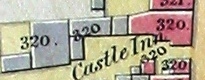 The tithe return for around this date shows the Castle and its outbuildings.
It possessed a theatre in 1904; was the Head Quarters of the Brentford Philanthropic Society (J J Cowley secretary) in 1913.
A former resident remembers it in the 1930s as 'a pub with a dance hall above it & premises for solicitors offices'.
In the 1909/10 Valuation Returns it is described as: 208 High Street "Castle Hotel" Licensed house, concert room, yard, stabling, garden, office & premises, extent ½ acre, owned by Captain Charles P B Wood DSO, Culmington, Bromfield, Salop, occupier P H Jones.
Freehold. Superior Interest leaseholder: Barclay Perkins & Co Ltd, Park Street, Southwark SE 99 years 25 Mar 1884.
Rent £100 & £200 per annum in lieu of premium etc.* 28 Aug 1907
* Agreement since granted @ £104 pa for rent & use of fixtures & fittings. Rights of light, support & drainage(?). Restricted to licensed premises. Leaseholders require Castle Hotel & Office, which are separately let, to be separately valued. Particulars 'see file'.
Gross value: £3512.
Following closure of the Castle in 1936, Brentford Post Office was built on the site in 1960 (Q64 / trade directory). In 2002 the post office building was converted to Jenny's Restaurant (hamburger chain), an estate agents and a dry cleaners, with flats above(L).
Photos/Ephemera/Maps
Links are included below to some photos, ephemera or maps accessible on this site. There may be additional photos on the site - suggest you check the Properties - photos link to the left.
References such as '1899 (A11)' indicate the date of a photo (1899) and where it is published (A11). Details of 'A' are available: see Mainly paper sources page; '11' refers to the page no, or photo no. in the publication.
196 Titus Ward, grocers c 1905 (D6)
197 ca 1905 (D7); Red Lion, ca 1907; Red Lion, ca 1908 (A58); postcard around 1909 shows Red Lion and numbers 198 onwards
198 ca 1905 Red Lion PH (D7)
200 1909 advert Martin's City Cigar Stores (L)
204 F F Pooles butchers ca 1910 (A57) (opposite Bradburys)
206 part of 206 in 1897 photo; 1910 (C16) & (Q64); postcard 1930; June 1966 (A57); June 1966 (A57);
207 as 206
208 Castle, 1897 photo;Oblique view of Castle 1920s postcard; The Castle, 1930s postcard; Post Office June 1966 (A57); as 206
1838 Tithe map modern numbers 196 to 208 are tithe property refs 309 to 320
1894 Ordnance Survey Map annotated with house numbers
Roads Off
Red Lion Yard between 198 & 199
Published 2006; last updated April 2022