Basics
Home and SearchSite Guide
Brentford Basics
Privacy Policy
Contact
People
FamiliesPhotos of people
Name indexes incl WW1
Memories
Lists, Documents, News
Occupations
Properties
Properties: High StreetProperties: non-High Street
Photos
Maps
1909/10 Valuation Index
Pub Hub
Can You Help?
Seeking...Mystery photos
Roads Off
A-Z listJanet's Research
HistoryBeach's Jam
Nowell Parr
Turner the Artist
Queen Victoria 1840
Brentford Market
80 High Street
Clitherow of Boston House
Four Croxford Brothers
Sources & More
They SaidBooks etc.
Web Links
Next
Site Technology
Author
Home and Search
Not Brentford
Numbers 7 - 35 High Street, Old Brentford
This is a long stretch on the south side of the eastern end of the High Street and runs from the house after the Almshouses to Smith Hill. This section of the High Street was listed as 'Front Street' in the 1851 census, presumably in contrast to 'Back Lane'.
In 1840, starting from the eastern end, this stretch contained about two dozen properties, interrupted by various small courts running south towards the river, then a flour wharf, the gas works, the Brewery Tap, the Royal Brewery, Half Moon & Seven Stars, the Royal Hotel, St George's vicarage then half a dozen properties leading up to Smith Hill.
Waterman's Park now occupies part of this area.
Properties
To the west of the almshouses at number 6 about 20 properties were listed in the 1841 to 1871 censuses. These properties also appear in the tithe enumeration in 1838/40 and it is possible to match several occupiers with head of household from the 1841 census. So far, so good. However there is not much continuity between the 1841 and later censuses so it is difficult to pin down people to properties.
Several properties in this stretch were lost between 1865 (OS Map) and 1881 (census) as the Gas Works expanded. Numbers 9 to 12 survived until the 1901 census but had gone by the time of the 1909/10 Valuation returns (which took place from 1909 onwards).
To account for the properties which were demolished before the High Street was numbered in 1876, I have given these properties references 19-1 to 19-17. There were also more properties in the Brewery area occupied in 1841 than in later censuses, these extra properties have references 23-1 to 23-3.
The western end of this section has Smith Hill as its boundary. Street directories record the loss of properties on either side of Smith Hill: in 1913 it was recorded between numbers 34 and 36 High Street, in 1920/21 and 1933 between numbers 32 and 37. By 1940 Smith Hill was between the Gas Light & Coke Company to the east and Thames Villa, then 41 High Street to the west.
Notes prepared for numbers 7, 8, 9, 11, 12 (Grand Junction Arms), House on eastern corner of Knights Buildings (19-9), Flour Wharf, Gas Works (20), 21, Brewery Tap (22), Royal Brewery (23), Brewery House (24), Half Moon & Seven Stars (25), Royal Hotel (26 - 27), St George's Vicarage (28), 29, 30, 31, 32, 33, 34 and 35; also a list of photos, ephemera and maps
Number 7
Tithe records of 1840 show M E Burford owned a pair of semi-detached houses to the west of the almshouses. The sequence of recording in the 1841 census suggests John Baker was in no. 7, Mary Burford in no. 8. John Baker, bargeman, was 70 and his household comprised himself, Elizabeth Baker, 45 and Joseph Baker 14. Mary E Burford was 70, independent, and occupied the next property. In 1851 an empty property followed the almshouses and Joseph Baker, master engraver, 23 was next; also in his household were his aunt Elizabeth Baker, 56 and sister Jane Baker, 18. There is enough information to be confident this is the same Baker family as recorded in 1841. Mary E Burford's death was registered in Brentford in 1849, age 87; perhaps upon her death Baker moved into her home? Working as an engraver, Joseph would have less need of river frontage offered by no. 7 than John Baker, bargeman.
The 1861 census records George Clark, 23, waterman and his wife Emma, 23, in the property after the almshouses. Both were born in New Brentford.
Thomas Banyon, 61, retired baker born Old Brentford was recorded here in 1871 with his Isleworth-born sons, Thomas junior 27, Robert 23 and Alfred John 18. Thomas junior was an organist and ditto marks suggest his brothers were too. They had a servant, Eliza Goddard, 27.
In the 1881 census Mrs Sarah S Thick from Shefford, Bedfordshire is listed at this address, with no occupation given. Living with her were her daughter Louisa, a dressmaker and son Thomas, a painter & (sign) writer, both born locally. In 1891 the house was occupied by Miss Martha Thick, costumer & Thomas, sign writer. Miss Martha Thick, dressmaker, aged 50 is head of household in 1901 and her sister Louisa lived with her. Miss Martha Thick appears in 1913 & 1920 trade directories at this address.
The 1909/10 Valuation Records describe it as a semi-detached house next to the Almshouses with a top floor attic, and two rooms on the first and ground floor, a basement cellar, kitchen and washhouse. It had a side entrance, was in 'very fair repair' and 'the garden runs to river at rear and goes partly behind no. 8 High Street'. The owners: The Misses M & L Thick, 'in occupation'. It had a frontage of 18'.
North Thames Gas Board records (held at the LMA) include documents relating to the freehold messuage of Miss Martha Thick 1897 - 1922 at 7 High Street. The property was sold to the Brentford Gas Company in 1922/3.
Edwin Butler lived here in 1928; the property is not included in the 1933 trade directory.
Number 8
On the eastern corner of Poppets Parlour. The head of household for this property was Mary E Burford, independant (1841), she owned this property and number 7. In 1851 the occupant was Joseph Baker, engraver (master) - see notes for number 7.
George C Trewby, 22, gas engineer lived here in 1861, with his housekeeper, Caroline Turner, 40, and brother Joseph Henry Trewby, 24, 'Chancellor of the Turkish Embassy at London'. They were followed by Ernest A Faunch, grocer clerk (1871); Mrs Elizabeth Barnham, caretaker of parish house (1881); Alfred Barnsby, barge builder (1891); John Barker, lighterman (1901).
North Thames Gas Board records (held at the LMA) include documents relating to the freehold premises of Mr Courtain Thomas Chivers at 8 High Street, 1896 - 1905 and executors of J J Dorey 1905 - 1922. These names do not appear in the 1891 or 1901 censuses. A John J Dorey, stone mason, lived at no.351 in 1881 and other Doreys are recorded on the High Street from 1861: more details of the Dorey family.
The 1909/10 Valuation Records list the owner as John J Dorey of 39 Boston Road Brentford and describe it as a semi-detached house - presumably with no. 7 - with passage way at side.
In 1911 Walter Charles Baker, 52, gas meter tester for the gas works lived in this 6-room house with his wife Clara Rose, five sons and a a daughter, ages 12 to 20. The father was born in Stratford, Essex and his children in Walworth, Surrey: no obvious connection to the Baker family who lived here or nearby in 1841 and 1851.
Clara Baker's letter of 16 September 1909 praising Wincarnis Wine featured in an advertisement in the Yorkshire Evening Post, 26 November 1909:
... it saved my husband's life. Everybody was telling me he would not live the winter through, but he looks a strong man again, and says he feels as well as he did 10 years ago ...'
She gave her address as 108 High Street, Brentford.
The death of Walter C Baker, age 55, was registered in Brentford in the October to December quarter of 1911.
It must be his son, Walter Reginald Baker, who was recorded at this address in trade directories of 1913, 1920, 1928 and 1933. There is no reference to no. 8 in the 1940 trade directory.
Number 9
The tithe apportionment for Ealing notes John Snelling as occupier of a house owed by John Bond. The accompanying map shows his home was set back from the High Street, behind Poppets Parlour. At the whim of the census enumerator it may have been counted as part of the High Street or Poppet's Parlour. Having reviewed Poppet's Parlour and its residents in 2023, I think it was most likely counted as part of Poppets Parlour and less likely to be no. 9 High Street.
There is no certainty about later residents until the High Street was numbered.
The first firm occupancy of no. 9 comes in 1878 when John Jones, boot and shoe maker, was recorded in the Post Office directory at this address. In 1881 two households, a total of six people, occupied no. 9: William Hattersley, garden labourer headed a household of four and Miss Emma Gillard, laundress with her younger widowed sister Jane Berryman.
By 1890 James Stevens ran a coffee house at no. 9. In the census of the following year James Stevens is described as an engine driver; perhaps his wife ran the coffee house. He was 42 in 1891 and headed a large household: wife, six children, a visitor from Winchester and an Irish lodger Hannah Sweeney with her baby boy Henry, 6 months.
Kelly's directory of 1898 again records James Stevens' coffee house at this address but he had moved away by the time of the 1901 census, when no. 9 was uninhabited but in occupation. A directory of the same year records the Imperial Type Foundry at this address. In October 1901 a fraud case was heard at the Old Bailey in which William Frederick Thomas Davey was a witness; he stated 'I am a printer - from October 25th, 1899, to April 27th this year I was employed at the Imperial Type Foundry, 9, High Street, Brentford', so it would appear the company was set up in Brentford around 1898/9.
By the time of the 1911 census Brentford Gas Works occupied the site of number 9 and properties to its west.
Number 11
Originally I concluded Mrs Anne Gomm lived here, but research from May 2023 suggests most likely she lived in Poppet's Parlour, perhaps in the block that was on the High Street. In any case, she was a widowed 'pottle basket maker' and remained in the same area, possibly the same property, in 1841, 1851 & 1861, by which time she was 67. Pottles were baskets used for packing fruit for market - see Occupations for more information on basket making.
In 1891 & 1901 no. 11 was a sizeable lodging house or beerhouse. In 1891 over 20 people lived here. In 1901 George Buss, licensed victualler, headed a household of 17 including 9 boarders. According to a descendant, George remained at number 11 in 1902, but by 1904 had moved across the road to number 386, where he remained until 1927. Another relative, Benjamin Buss, lived at number 388. George Buss is known to have run pubs called the Harp & White Hart, so it is possible that number 11 was one of these.
Number 12 (Grand Junction Arms)
Occupancy before the High Street was numbered in 1876 is not clear: occupants of surrounding properties changed from census to census. A William Gye, beerseller, was recorded in this area in the 1871 census, and it seems likely that he was at no. 12.
John Farrington was recorded here in an 1878 trade directory, the 1881 census and an 1882 directory. In the census his occupation is 'lighterman', this must have been his day job, in the evenings he was a 'beer retailer'. He had four children aged 3 to 17 and two male lodgers. His property was next to the Gas Works by 1881, any buildings inbetween having been demolished.
The Grand Junction Arms was no longer operating by 1890: Samuel Perry, a foreman at the Gas Works, is recorded at 12 High Street in a trade directory. His occupation in the 1891 census 'Engine Smith': he was born in Hayle, Cornwall, his son Samuel, age 5, was born in Brentford. The family remained at no. 12 in 1901 but by 1907 there is no reference to no. 12 in a street directory, it had been demolished to allow the Gas Works to expand.
House on the east side of Knights Buildings ('19-9')
In 1851 this property was occupied by two households, one headed by George Cradduck from Staplehurst, Kent (formerly an agricultural worker but now a grocer in business) who shared it with his Mother-in-Law Ann Partridge from Birmingham, his wife Ann, daughter Jane and sons Alfred, Arthur and George.
The second household in the house was occupied by widower James Cradduck from Staplehurst, Kent. He was working as an "engine man" at the local water works. Also sons James, Charles and George. (Thanks to Martin, descendant of the Cradduck family for passing on this information).
Flour Wharf
The flour wharf is recorded in the tithe enumeration as a 'wharf warehouse' owned by George William Andrews, who lived at number 334. The 1871 census includes a reference to the building 'flour wharf employing 4 men'. It was lost when the gas works expanded (1894 OS Map).
Gas Works (number 20)
The Gas Works closed in 1963 (A25); at its largest the works covered 8½ acres on both sides of the High Street (A26). The Brentford Gas Company was incorporated by an Act of Parliament in 1821. Its main works lay on either side of Brentford High Street, with a long frontage to the River Thames. Due to its location, expansion of the gas works was limited. In 1868 the company built a new works adjacent to Montague Road in Southall. (I).
Brentford Gas Works by David Shailes has a full history. The LMA has documents about the Gas Light & Coke Company.
Number 21
Sir Felix Booth was the owner of a 'house, yard, garden & premises' and he and John Booth were listed as the occupiers at the time of the tithe return: 1839 / 1841. As well as being famous for Booths Gin, Felix Booth also founded the Brentford Gas Company in 1820 (A24). In the 1841 census John Booth, aged 35 (as ages were rounded down in this census he could have been up to 39) lived here with two male and one female servants. The gas works expanded on to the site formerly occupied by the Royal Brewery in 1926 (A24).
Brewery Tap (22)
Next to and owned by the Royal Brewery.
James Cuishen, beer retailer, recorded here in an 1853 trade directory.
Henry Kate, beer seller lived here in 1861; Albert M Steele had taken over by 1871; William J Goodwin - 1881.
In the 1890 trade directory Harry Blake was at the Brewery Tap; he appears as Henry Blake, mineral water manufacturer in the 1891 census. According to his great grandson, Peter Blake, Harry remained at the Brewery Tap until about 1900, when he and his young family, including Peter's grandfather Augustus born 7th October 1890, moved to Argentina.
In 1901 James Marriott from Oxford had taken over and remained here in 1907 (trade directory).
In the 1909/10 Valuation Records the Brewery Tap is given the next consecutive property reference after no. 8 High Street, indicating the buildings in between were empty or demolished. It had two bars and a bar/parlour on the ground floor, was brick built with a slated roof, in good condition. It had a frontage of 36' 6" and gross value of £4000.
In the 1911 census Thomas Turner, age 45, beer house keeper, lived here with his wife of 22 years Elizabeth, who assisted with the business, son Albert Victor Turner, 14, at school, only surviving child of four children, widowed aunt Emma Kirby, 72 and widowed servant Phove (Phoebe?) Parrish. The property had eight rooms.
Thomas Turner was still there in 1921 & presumably remained until the pub closed in 1923.
Royal Brewery (23)
Founded in the C18 & called the Red Lion Brewery until 1829 (A32). John Hazard owned 4 houses & the Brewery at the time of the tithe return (1839 / 1841). In 1841 he lived in one of these houses, near to or part of the Brewery (possibly no. 24 High Street), with a housekeeper, housemaid and footman living in; he remained here in 1851 and 1861 - by which time he was 78 and a fund holder.
1907 and 1911 trade directories note S C Leonard was secretary to the Royal Brewery at 23 High Street.
Described in the 1909/10 Valuation records as having 'valuable frontage to High Street'. The accompanying plan shows three substantial buildings (eg 56' by 95') described as 'Brewery, bottling stores, house, office, stabling & premises' and mentions 'vat rooms & store rooms', 'all buildings well built and in good condition'.
Brewing ceased in 1923, the buildings were demolished 1926; the site is now (1983) part of Waterman's Park (C58).
LMA has documents from Courage, Barclay and Simonds (Brewers), created by the Medway Brewery and Anchor Brewhouse of Southwark relating to the Royal Brewery Brentford (I).
Brewery House (24)
The Brewery House provided living accommodation for the brewery manager and was one of four houses recorded on this site in the tithe return (1839/1841).
By 1888 Henry Taylor lived here. The 1891 census lists Henry Taylor, brewer's manager, 47, his wife Emma, family of six sons, visitor Sarah Holley and two servants: Emily Parslow and Elizabeth Pearce, both 17.
The 1901 census shows Dorey's timberyard between numbers 22 and 25 High Street, no reference to Brewery House.
In 1911 no. 24 High Street was occupied by Philip Sargeant, 49, caretaker of Brewery House; his wife Mary Eliza, 44, housekeeper of Brewery House; and her widowed aunt Sarah Gillham, 55, general servant domestic. The property had nine rooms.
Half Moon & Seven Stars (25)
Listed from 1839 (Pigot's Directory) - 1901 census. In 1839 / 41 the owner was Douglas Thompson, who owned four other Brentford High Street public houses: the Feathers at no. 232, the One Tun at 254, the Red Lion at 318 and the Marquis of Granby at 369.
Local man Robert Pearce was the landlord in 1839, 1841, 1851 when it is described as the 'Half Moon and Seven Stars Lodging House' and 1861; Robert was described as a 'licensed victualler & waterman' in 1851. There were 8 lodgers in 1841, 9 lodgers and a visitor in 1851 and 5 lodgers in 1861.
By 1871 Charles Gibbins had taken over, and he was succeeded by John Fairchild by 1874, who was succeeded by Mrs Annie Moffatt, 'licensed victuallers wife' in 1881. The 1881 census shows Annie, age 26 (born Ealing), with her daughter Elizabeth 2 (Chiswick), and mother Elizabeth Woods, 64 (Harefield). Three boarders: Richard Hamerton 19 lighterman, James Snelling 20 lighterman and Charles Grint 48 wheelwright; plus two lodgers who were labourers, William Allen 45 and James Taylor 42, completed the household. The boarders and lodgers were all born in Middlesex or London.
Bruce Willoughby added the following biographical details for Annie Moffatt in July 2015: 'Annie Moffatt was born Annie Woods in 1855 and married Walter George Moffatt in the first quarter of 1875 at Brentford. I have no idea why they were living apart at the time of the 1881 census as Walter was also a licensed victualler living at High Street, Uxbridge, shown as married and with the only other inhabitant a visitor. Perhaps they were running 2 businesses, perhaps they had separated. Who knows? Annie died in September 1885 and Walter remarried. The daughter Elizabeth is Elizabeth Maria C.Moffatt and she moved with her father and stepmother to Limehouse by the 1891 census. The Richard Hamerton is probably misspelled as the family name is Hammerton with 2 m's.'
Thomas Waight had taken over by 1890 and in the 1891 census was recorded with his son George Waight, a labourer, and a servant, Harriett Bradshaw. Thomas Waight's death was registered in the last quarter of 1894.
Londoner Samuel Ferris lived here in 1901. (An older Samuel Ferris ran the Marquis of Granby in 1901).
The Half Moon & Seven Stars closed around 1903 (Y70). There is no reference to 25 High Street in the 1911 census and by the 1920s the gas works had expanded into this area.
Royal Hotel (26 - 27)
James Stout was recorded at the Royal Hotel in the 1841 census.
A note in the St George's Parish Magazine from 1st June 1885 'Upton House, no. 26 High Street, will be ready for use as the new Parish House. No. 8 will be given up at Michaelmas' (L).
In the parish magazine published in 1898 there are references to 'St George's Church House' at no. 26 High Street, care taker Mr. Maslin.
1898 trade directory: 'St George's Parish House, No. 26 High Street, has on the ground floor a parochial library and a kitchen, and on the second floor two large rooms, open every week night to the members of the Men's Social Club, founded in 1885, and now has over 100 members'.
Another notice from 1898 refers to the Men's Social Club meeting at the Church House 'Reading and Recreation Rooms', open on week-nights from 6.30 to 10.30.
The Royal Hotel belonged to the Royal Brewery and was built by Felix Booth; the building was altered in the early 1900s and demolished in 1927. The site was used for an extension to the gas works and now (2002) part of the Waterman's Art Centre (Q110). North Thames Gas Board records deposited at the LMA include counterpart of a lease dated 1838 for the Royal Hotel premises, with stables, vaults, cellars etc. (I). Vic Rosewarne has looked into some inept burglaries at the Royal Hotel in 1893 and 1897, which paint a picture of the setting of the building (unfortunately the site does not yet have a photo showing it).
St George's Vicarage (28)
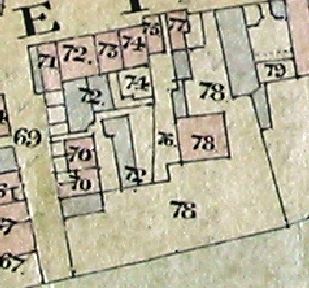 This image is reproduced courtesy of Corporation of London, London Metropolitan Archives.
The tithe map shows a square block of ground west of the Royal Hotel and brewery site, bounded by the Thames to the south, Smith Hill (69) to the west and High Street to the north. Around half the area was owned by Thomas Harrington and Sir Felix Booth, brewer and distiller; the rest was owned by others, as noted below.
In the tithe the block contained seven properties accessible from the High Street (later numbered 28 to 34) and three on the east side of Smith Hill.
The closest building to the Royal Hotel was plot 78, a house and garden owned by Thomas Harrington, area 1 rod 6 perch, occupied by George Osborne. It was accessed from the High Street but well set back from it, with a long frontage to the Thames. Its setting and later maps confirm this was later the vicarage for St George's church. The following description accompanies a postcard view of the vicarage taken from the Thames:
The vicarage of St George's church situated just west of the Royal Brewery, approximately 100 yards from the church on the river side. It was demolished in 1931 as part of the gas works expansion. (A30)
The property was recorded as uninhabited in the 1841 census.
Frederick Whitehurst and family occupied 'River Side', which was recorded next after the Royal Hotel in the 1851 census. He was 35, a brewer, born in Bloomsbury and his household comprised his wife Kate, 24 born Westminster, daughter Mary age 1, born Brentford, mother-in-law Henrietta Hunt 63, nephew George Hunt 10 and married brother-in-law Alfred Hunt, a merchant age 35, plus three female servants not born in Brentford.
He remained here in the 1861 census: Frederick Whitehurst, 45, auctioneer, wife, three children and two female servants.
The 1866 Post Office Directory noted the Rev. Francis Edward Thompson, BA of Trinity College Oxford was the incumbent of St George's, but he had an Ealing Lane address. It seems no. 28 became the vicarage between 1866 and 1871.
In 1871 the vicarage was the home of Samuel More Richards, married, 68, Stipendiary Curate St George Old Brentford, born Totnes Devon, two unmarried daughters Ada Eliza 35 born Somertown, Oxford Mary Elizabeth 29 born Stonecliff Hall Derby; and two servants, Martha Ann Parker 21 born Brighton and Emma Richardson 17 born Strand on the Green.
The 1874 Post Office Directory for Middlesex records Rev. Thomas Edward Platten, MA, of Lincoln College, Oxford, as the vicar of St George's; by the 1878 edition he had been succeeded by Rev. William Templeton King, MA, Trinity College, Dublin.
In the 1881 census William Templeton King, 31, born in Ireland, was living in the vicarage with his wife Beatrice Norton King, 19 born Islington, Elizabeth I Twells mother-in-law 57, Margaret Twells sister-in-law plus two servants, perhaps sisters as both were born Woodlands, Dorset: cook Elizabeth Froud 20 and housemaid Laura Froud 18.
William and Beatrice had married the previous year at St Mary Ealing, with six witnesses present. The King family remained in the vicarage in 1891, by which point they had three children, ages 2 to 8, all at school, and two female servants, ages 19 and 16, neither born locally. Later, King was Vicar of Christ Church, Ealing.
In 1901 Rev Thomas Selby Henrey was living at St George's vicarage with his wife 'Harriet E.S.' and Harriet's sister Ann E. Lindsay. What the census doesn't show is that Harriet was expecting a son, Robert Selby Henrey; his birth was registered at Brentford in the July - September quarter of 1901, at Brentford. Interested to find out more about the Henrey family?
I am indebted to Jeremy Kite for a reference to a 'newsletter' sent on a monthly basis between 1910-11 to those connected with, or serving, Trinity House. He describes it as:
"a bit like ' Lighthousemen Monthly', it contains lots of information about shipwrecks, exploits and adventures. It has a strong religious flavour and a thoroughly 'masculine' and 'seafarers' feel to it throughout. ...
On page 406 the author offers a 2/6 prize for the 'most interesting and best written paper on natural history ... These might have to do with the habits of sea-birds ...' and offers the return address for contributions: Mrs Henrey, St George's Vicarage, Brentford. W.
So, this hearty and lusty guide to life in Trinity House, shipwrecks and seafaring yarns was compiled by ... the vicar's wife!"
Jeremy asked whether I knew of the burial place of Thomas Selby Henry. It appears he was living at Westaway, Godalming, Surrey in 1937 (telephone directory) and there is a death registration in 'Surrey SW' registration district in the January - March quarter of 1941: he was aged 82.
The detached vicarage stood in its own grounds and had a frontage of just 10' 5" to the High Street but 'a long frontage to the river and a short frontage to Smith Hill'. The property consisted of
- Top floor: 5 rooms, a dressing room, bathroom, WC
- Ground floor: 5 rooms, kitchen, WC, entrance hall
- There is a detached building originally used as a laundry but now disused with one room on the first floor and one room on the ground floor
Thomas Selby Henrey remained here until his retirement in 1930 and then moved to Godalming. The vicarage was demolished in 1931 to make way for the Gas Works expansion (Q51).
If you are interested in the Henrey family, ‘The King of Brentford’ is about the family’s life in Brentford. It was written by ‘Robert Henrey’ ie Mrs Robert Henrey, Madelein née Gal, a French woman who married Robert Henrey in 1928. The book re-names the family 'Rayhen' and mentions other Brentford families, their names sometimes disguised. A summary of those featured in the book is on a list of things to be added to the web site.
Number 29
The tithe map and enumeration show 'John Sadgroves' in the property that was eventually number 29. The 1841 census shows John Sadgrove, a labourer, in this area, also in 1851 when he was a shopkeeper (grocer) of 'Front Street', as this part of the High Street was named in the census.
In both censuses he was two doors away from William Ralfs the surgeon, further confirming John's home. John died leaving a PCC will proved in 1852. His wife died a couple of years later and by 1861 widow Jane Kemish was living in this property with her two sons, Henry, 41, a whitesmith and his brother Edward, 24, no occupation recorded.
Ten years on, in 1871, the small Kemish family remained at no. 29, Jane by then 76. Her two sons remained unmarried, both were tinplate workers.
The 1881 census shows Edward Kemish, metal worker, with wife Annie, daughter Sarah (10) and son Walter (8) at 29 High Street.
There is an entry in an 1890 trade directory for William Truswell & Sons, heating engineers at no. 29. The property was uninhabited in 1891. In 1901 Henry E Blenkinsop, cycle manufacturer, age 25, lived here.
1911: Emily Ruth Crane (59), general shopkeeper, lived here and ran the shop, helped by her widowed sister Alice Maud Pitts (54), both were born in Stepney. Lydia Dixon, widow, 74, lodged with them and local girl, Annie Baker, was the domestic servant. The property had 5 rooms.
The 1909/10 Valuation describes no. 29 as a detached house and shop of 3 storeys with 2 attics on the top floor, 2 rooms on the first floor and a shop, parlour and side entrance on the ground floor. The property had a cellar and small side garden. 'This property is old and all the brickwork need repointing.'. It had a wider than average frontage, 21' 8" and the owner was Miss A Newens of 327 High Street, with a 'subordinate interest' : James Clapp of Chiswick, for 21 years from 24 June 1895. The rental was £20 per annum.
1913 and 1920/1 directories show Crane & Pitts, general shop at this address, then in 1933 Mrs Pitts, general shop. Gas Light & Coke Co listed here in 1940.
Number 30
This was plot 75 in the tithe apportionment and was owned by the executors of Richard Rogers, who died in 1840. In the 1841 census the head of household was Ann Rogers.
No. 30 has the same building line as its neighbour. no. 29, both projecting into High Street. The property had no yard or garden, the land behind in, plot 76, being ‘vacant ground’ owned by Sir Felix Booth in 1840; it was accessed by a small gap between numbers 29 and 30.
In 1851 James Nash occupied the former Rogers’ family home. He was a basket maker, 38 born Maidenhead Berkshire, wife Emily 42, born Egham Surrey and the couple’s five sons, age 4 to 15, were all born in Brentford. Richard Britton, 50, a married bootmaker, born Reading Berkshire and Henry Baker, brother-in-law, 26, excavator born Egham completed the household. Nash remained here in 1861, age 49, general dealer, with his wife and family.
In 1871 James Weatherly was recorded between Kemish and Ralfs, placing him in no. 30. He was 42, a building labourer born Hillingdon, his wife Ann, 40, was born in Ireland and they had 5 children, ages 6 to 13. all born Old Brentford.
The Weatherly family had moved away by 1881 as the occupants then were Isaac Brooks 39 baker, born Cookham Oxfordshire, wife Esther Ann 38 born Hanwell and 8 children ages 3 months to 17 all born Brentford.
A 1912 line drawing shows a two storey plus attic property with the shop name of W Berry 'greengrocer & dealer'; by the window there is a sign saying 'English & Foreign Fruiterer'; the 1901 census includes a William J Berry, aged 51, (seller of) crockeryware and the 1913 directory shows a William Berry, china dealer at number 30, a business he was still running in 1921 (but not 1928). So where the greengrocer description comes from is a mystery!
The 1909/10 Valuation records describe the property as a 'very old semi-detached cottage and shop' owned by a Mrs S C Furness, Manchester. Gas Light & Coke Co listed here in 1940.
Number 31
The tithe shows a terrace of three houses owned by the executors of John Round in 1840. This is the eastern one. In 1840 the occupant of the house and garden was William Ralfes.
In 1841 William Ralf 60, surgeon, was the head of household and Maria, 50, was probably his wife and Samuel (20) his son and Emily (15) his daughter. They had a female servant named Clarke 18. Next to them was another surgeon, Francis Bonney. This was marked up as a separate property, suggesting he and his family lived at no. 32.
In 1851 William Ralfs household included his grandson and granddaughter named Bonney.
Ten years on, in 1861 the property was occupied by Samuel Ralfs, 42, surgeon, his mothern Mary Antoinet 75, sister Emmeline Agnes 39 and servants Sarah May 22 and James Bartholomew 12.
In 1871 Henry Charles Ralfs 66 medical assistant born Harwich Essex, his wife Susannah 50 born Hammersmith and daughter Ellen Donaldson Ralfs 18 born Chiswick.
Susannah Ralfs died in the last quarter of 1875, age 63 and her husband Henry Charles Ralfs died in the first quarter of 1881, age 75. In the 1881 census the occupants of no. 31 were Ellen Hetherington, unmarried, guardian 58 and Ellen D Ralfs 29 'defective speech', both born Hammersmith.
The County of Middlesex Independent trade directory of 1888 records 'Miss Ralfs' at this address.
The land value survey of 1910 describes number 31 as a terrace house and shop with two rooms on the top and first floors, a good shop and parlour on the ground floor and a basement kitchen with an outside WC, washhouse and coal cellar. Back elevations need pointing. Premises otherwise in very fair repair. Wash house runs slightly behind no. 32.
Both numbers 31 and 32 were owned by Henry Franklin of 19 Queens Road , Twickenham & Albert J Ruff, Coombehurst, East Twickenham.
In the 1911 census number 31 was occupied by George Patfold Abbott, plastour decorative, his wife Alice Ethel Abbott, manageress piano shop, and their two sons George Henry, 5, and Alfred Arthur, 5 months. The family had moved to Brentford during the last five years. Their home had 5 rooms.
In 1913 Willmott & Co., pianoforte dealers had their premises at no. 31 and remained here in 1920/21 as Willmott and Son. 1928: H. Willmott & Son, musical instrument dealers were based at number 31 and also 234 High Street. In 1933, H Willmott were at no. 31 only and in 1933 presumably the same H WIllmott was at 50 High Street, cycle dealers.
Gas Light & Coke Co listed here in 1940.
Number 32
The second house of the terrace recorded in the 1840 tithe as owned by the executors of John Round: plot 73, a house and yard of area 2 perch, occupied by James Alderson.
In 1841 the property between the Ralf and Round families was occupied by the Bonney family: Francis Bonney, surgeon 35 and his wife Maria 25 and their three children.
In 1851 and 1861 the property recorded next to the Ralf family was uninhabited.
The land value survey of 1910 describes the accommodation of number 32 as no. 31 but there is no outside washhouse & the WC runs at the back of no. 31.
In the 1911 census no. 32 was recorded as uninhabited.
Listed in trade directories until 1933, Gas Light & Coke Co listed here in 1940.
Number 33
In the 1839 / 1841 tithe apportionment 'Round, executors of'' owned three properties which later were numbers 31, 32 & 33. Gavin Meeser, descendant of John Round, says John was a grocer in the High Street, Old Brentford in the early 1830s who committed suicide in 1839. His wife Ruth Round ran the business after his death. Read an account of John Round's demise.
The 1839 trade directory includes John Round grocer, the 1841 census shows Ruth Round, grocer, heading a household of 7 including a female servant and an apprentice. She was 45 (in practice this could be up to 49, as ages were rounded down in this census).
The 1851 census is confusing as it records three properties before Smith Hill, whereas in later censuses there were two. For now the occupants of the two properties are recorded together:
- William Harradine, a painter employing one man. He was 30, married to Edna nd they had two sons; they had a live-in nurse, Esther Bell. This was the property thought to be next to no. 32. It was followed by
- William Sage, tallow chandler and Letitia Irish his servant.
In 1861 Henry Maysted, 49, lamp maker, lived here with his wife Frances 47, sons Richard 13 and George 11 and daughter Ann, 3.
John Baldry, fishmonger, lived at no. 33 by 1881 and is also recorded at this address in the 1891 census. See Baldry family notes for details.
In 1901 James Morris, London City missionary, lived here, heading a household of 6.
The 1909/10 Valuation describes no. 33 as a shop, house and premises, formerly sold on 6 April 1906 along with no. 34, 410 and 411 for £1400 (£350 subsequently spent on the four properties). The owner was Frederick Henry Ward. No. 33 was a brick and tile building in 'very fair order' with 2 rooms on the top floor, 2 rooms and a WC on the first floor and a shop and room on the ground floor. There was basement, storage, yard and WC. The property was on a plot around 70' deep. The 1911 census lists no. 33 as an uninhabited shop.
The 1911 census lists no. 33 as an uninhabited shop. The 1913 directory lists number 33 as a fried fish shop run by John Harvey; number 33 is not listed in 1920 and later (although there was a fried fish shop at number 32 in 1920, 1928 & 1933. Perhaps there had been some renumbering. See notes under number 34, below.
Number 34
This property was near to the eastern corner of Smith Hill.
Continuity of occupation of number 34 provides a link between occupants from 1851 to 1907.
In 1851 John Calvert, corn and coal dealer was here with wife Esther, four children aged 5 and under and Sarah Nichols, 16, a servant. The children were all Brentford-born.
In 1861 Joseph Martin was recorded after Smith Hill. He was a corn dealer, age 28 wife Mary Ann 27 and adopted child Catherine Waring, 5, all born Hammersmith.
1871: Adams Jarvis, his wife Anne and five children ages 1 to 13 were recorded after the Smith Hill Lodging House. He was a corn dealer (as was the occupant in 1861) and they had a live-in nurse, Harriet Andrews, 68, born Netley Hampshire, although in occupation she was recorded as a ‘char’. A daughter age 4 was born in Shadwell, the baby age 1 in Brentford: the family moved to Brentford between 1866 and 1870. His address is confirmed as no. 34 in the Post Office directory of 1878.
The Jarvis family remained at no 34 in 1881 at which point Adams Jarvis’s household was eleven-strong. He was a corn dealer, age 49, and born in Devon – a multi-syllable placename along the lines of Kenyedon Hall/Hill/Well. His second wife Sarah Anne was 31 and born in Stepney. Birthplaces chart the movement of the family: Battersea where the two eldest sons at home were born, then Wapping (age 14), then a burst of five children ages 6, 5, 3, 1 and an un-named daughter, one week, all born in Brentford. Nurse, Elizabeth Carter, 59, a widow born in Berkshire, was the 11th member of the household.
In 1891 Alfred Argent, corn chandler, was recorded at this address. He was 32, born in Isleworth and had a wife Carrie, 36, born Surrey and two daughters, Ada 6 and Anne 4, both born in Brentford. Edward Jarvis, 26, a labourer born Battersea, was lodging with the family - possibly a son of Adams Jarvis, the previous occupant. The family remained here in 1901, by which point Ada, 17, was working as a dressmaker.
Alfred was recorded in a 1907 street directory at this address, a corn merchant. Shortly after, the Argent family moved to 7 York Road and in 1911 Alfred was employed by the Brentford Gas Company as an automatic meter collector. Ada was a nurse and Annie a manageress of a dairy.
LMA has documents from the North Thames Gas Board relating to leasehold messuages and shops, numbers 33 & 34 High Street. 34 was let to the Salvation Army from 29 Sep 1908 at a rent of £26 p.a. Number 33 was held by yearly tenancy of Arthur William Horsley at 12s 6d per week. Frederick Henry Ward was the owner of 33-34 when the 1909/10 Valuation records were prepared. LMA holds a letter from Mr A W Horsley to F H Ward dated 1913 stating he was willing to leave 33 High Street whenever Mr Ward was able to let the house. (I)
When the 1911 census was taken, no 34 was occupied by two Salvation Army officers, William Girt, 27, and Ernest Ward, 22. The latter was born in Knaresborough, Yorkshire; Ward is a common name and it is not known if he was related to Frederick Henry Ward.
Number 35
A 19th-century painting shows a property occupying the corner plot with buildings extending down Smith Hill towards the river Thames. There is an inn sign showing a swan.
The tithe map shows it was a larger than average building fronting Smith Hill and it can be picked out in maps of 1865 and 1894.
No. 35 was a common lodging house occupied by over 20 people in the 1871, 1881 and 1891 censuses; Sarah Rogers was the head of household in 1871 & 1881 and in 1871 there is a note in the census suggesting it was known as 'The Swan'.
North Thames Gas Board records held at the LMA refer to 'a copyhold messuage in Smith's Hill Old Brentford, now 35 High Street, Brentford' (1890). In 1901: 'a copyhold tenement in Smith's Hill, house formerly there now destroyed, known as 35 High Street'. There is also a provisional valuation for Land Tax for number 35 in 1915. (I). The 1909/10 Valuation describes the plot as 'Land at Smith Hill with frontage to High Street, formerly known as 35 High Street'. It was owned by Charles Pascall and described as 'vacant land with advertisement hoarding'. A note dated 25/09/1917 adds 'site slopes away towards river'.
Photos/Ephemera/Maps
Links are included below to some photos, ephemera or maps accessible on this site. There may be additional photos on the site - suggest you check the Properties - photos link (the navigation area to the left).
References such as '1899 (X11)' indicate the date of a photo (1899) and where it is published (X11). Details of 'X' are available: see Mainly paper sources page; '11' refers to the page no, or photo no. in the publication.
Photos
Brewery Tap: pre re-fronting 1900 (C58); after refronting early 20C also in (A32) and 1905 (Y69)
Royal Brewery: early 20C also (A32)
Half Moon & Seven Stars (no. 25): early C 19 watercolour (Y70)
Royal Hotel (26/27 High Street): 1900 (C57)
St George's Church Rooms (26 High Street): references in St George's Parish Magazine 1885 and 1898 (L)
St George's Vicarage (no. 28): early 1900s (Q51)
No. 30 - Line Drawing 1912 (L - Chiswick Library)
1839/41 Tithe Map: modern numbers 7 - 20 have tithe property refs 112a - 89
1839/41 Tithe Map: Gas Works & Brewery have tithe property refs 89, 88 & 87
Maps
1839/41 Tithe Map: modern numbers 22 - 34 have tithe property refs 86 - 71
1894 Ordnance Survey Map annotated with house numbers 7 - 20
1894 Ordnance Survey Map annotated with house numbers 21 - 35
Roads Off
Poppet's (or Popet's) Parlour is listed in the 1841 to 1861 censuses as having 5 to 7 households; it was just to the west of the almshouses between numbers 8 and 9 High Street: read more.
Swan Steps is listed in 1841 to 1871 censuses as having 11 or more households; in C18 there was a notorious pub on Brentford Ait called the Swan or Three Swans, closed in 1796 (Q65), presumably Swan Steps led down to the river crossing to this pub. It lay 7 to 10 properties to the west of Poppets Parlour (ie between 19 and 19-1). Not recorded in the 1881 census and presumably demolished between 1871 & 1881.
Knights Buildings/ Steps lay 6 to 8 properties to the west of Swan Steps - listed in 1841 as 7 households, 1851 as 8 households and as Knights Steps in 1861 (4 households). Not referred to in the 1871 census.
Anns Court is listed as 4 households between numbers 19-10 and 19-11 in 1841 & 1851, in 1861 as 23 households, some of the 23 may actually be on the High Street.
Union Court was a group of 18 houses on land between the High Street and river Thames, between 24 and 25 High Street: more about Union Court.
Swifts Wharf: according to a document held at the LMA (admission of a tenant) dated 2 June 1851 there was a piece of land called Swifts Wharf south of the High Street and to the west of the Royal Hotel which had '7 cottages, since pulled down, and now has 2 cottages and copyhold land with dwelling house'. (I)
Smith Hill between numbers 35 & 36: notes are being worked on during 2022
Published 2005; last updated June 2023